
Use AI at work. Then test it, defend it and govern it.
AI is now part of security work: a tool people use every day, and a system attackers target. This roadmap is for anyone whose job now includes AI: using it with judgment, testing AI apps and agents, and setting the rules around them. It’s the order we’d learn it in. It starts with a free course, and we’ll be straight with you about which steps are open today and which are still being built.
What AI security people actually do
The work starts where AI meets real systems and real decisions. The day-to-day:
- Check AI-written summaries, queries and recommendations against the evidence before anyone acts on them.
- Decide what data may go into which AI tool, and what never goes in at all.
- Map how an AI app is built: the model, its instructions, the documents it retrieves and the tools it can call.
- Test AI apps and agents you’re authorized to test, and find where they leak data, follow hidden instructions or take actions nobody approved.
- Turn on safeguards, then prove the same failure no longer works.
- Read AI app logs and write detections for misuse.
- Write AI risk assessments and use policies, and brief leadership in plain language.
The titles vary: AI security analyst, AI security tester, AI red team member, AI security engineer, AI governance lead and AI risk analyst. Often it starts inside a role you already know, like the SOC analyst, pentester or GRC analyst who becomes the team’s AI expert.
Three roles on this path
- AI security analyst. Uses AI with judgment, spots when an AI tool is being misused or misled, and keeps sensitive data out of the wrong tools.
- AI security tester. Tests AI apps and agents in a lab or a scoped engagement, finds where they fail, hardens them and proves the fixes hold.
- AI governance lead. Decides which AI uses are allowed and on what terms, runs AI risk assessments, writes the policy and reports to leadership. From here the path connects to security leadership and the vCISO path.
They’re lanes, not a ladder, so you don’t have to take them in order. You can reach governance from GRC without testing first.
The AI in Cyber roadmap, phase by phase
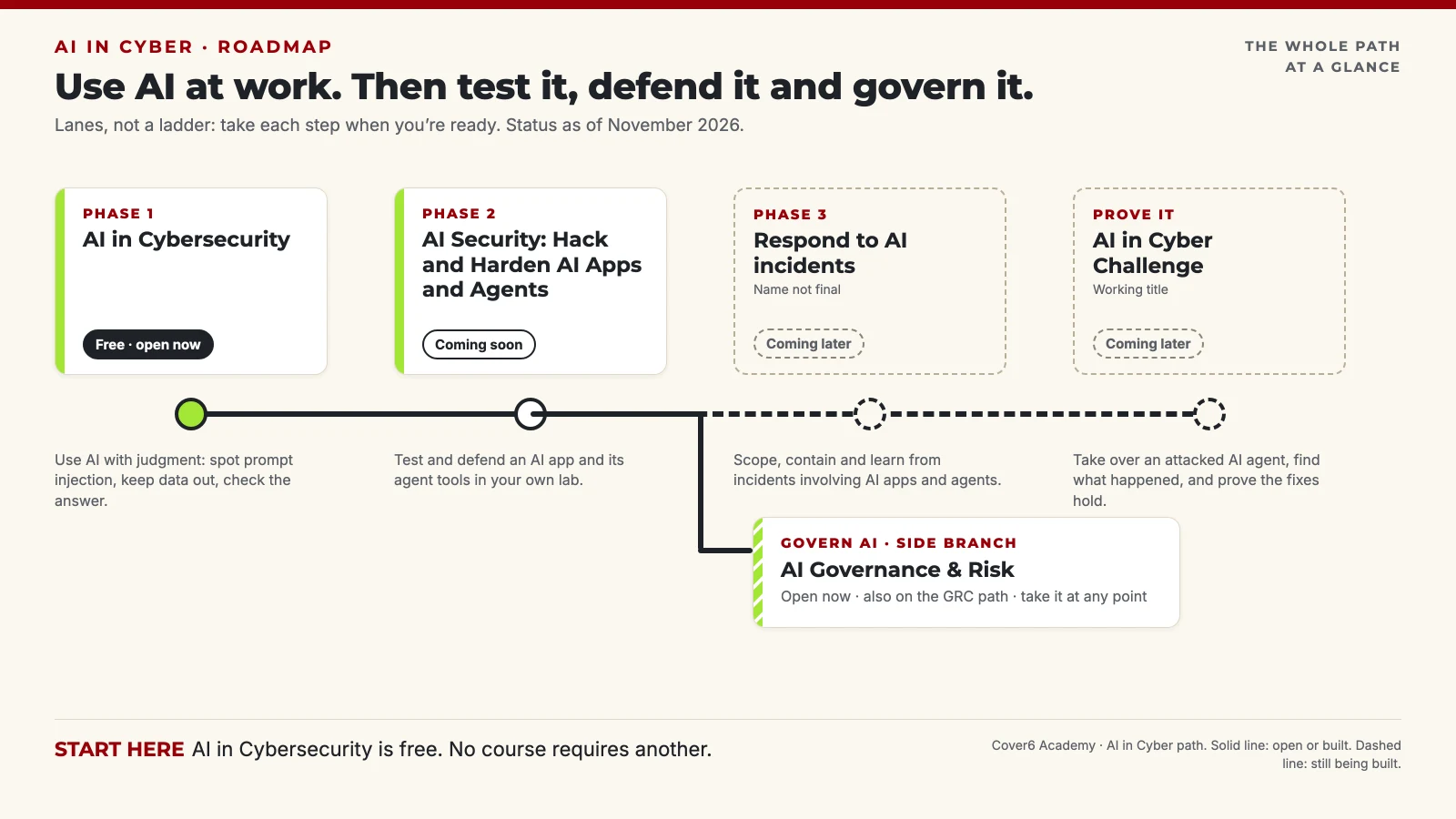
Phase 1: Use AI with judgment (free)
Start with how AI shows up in security work and how it fails.
Then do the work. AI in Cybersecurity is free. You’ll see how defenders and attackers use AI, spot prompt injection in content an assistant would read, decide what never goes into an AI tool, sanitize a work note before you paste it, and fact-check an AI answer against primary sources. You finish with a graded AI use review and a certificate with 5 CPE hours. No paid tools, sign-ups or lab needed.
What you’ll be able to do: tell rule-based automation, machine learning and generative AI apart, recognize direct and indirect prompt injection, keep sensitive data out of the wrong tool, and check an AI answer before you act on it.
Phase 2: Test and defend AI apps and agents (coming soon)
AI Security: Hack and Harden AI Apps and Agents is hands-on, in your own private lab. You assess Ask Odie, a student-help assistant at a fictional university: test it for prompt injection, data leaks, poisoned documents, unsafe output and misused tools; find your own tests in its logs and write detections; turn on the right safeguards; and re-run your tests to prove the fixes hold. You finish with an AI security assessment report for the university’s CIO. It isn’t open yet. The university and its assistant are fictional, and every test stays inside your own lab.
What you’ll be able to do: threat-model an AI app, test it against the OWASP risk lists, read AI telemetry, apply layered defenses such as least-privilege tools and human approval, and write a regression suite and a report an executive can act on.
Govern AI (open now; also on the GRC path)
AI Governance & Risk is for the people who set the rules. You run an AI risk assessment, write an AI use policy, review an AI system’s security and brief a board, using the NIST AI Risk Management Framework and ISO/IEC 42001. No lab needed. It sits on both this path and the GRC Analyst path, and you can take it at any point.
What you’ll be able to do: assess AI risk with a recognized framework, write a policy people can follow, and turn findings into decisions leadership can make.
Phase 3: Respond to AI incidents (coming later)
The third level is still being designed. It’s planned to cover responding to incidents involving AI apps and agents: scoping what happened, containing it without losing the evidence, designing agents with least privilege and writing detections that hold up. It isn’t open yet, and its name isn’t final.
Prove it (coming later)
An AI in Cyber Challenge is planned: working alone, against the clock, take over an AI agent that’s already been attacked, find out what happened from its own logs, contain and harden it, and prove the fixes hold. You’ll be able to take it anytime. No course is required first. It isn’t open yet.
Certifications on this path
You don’t need a certification to start. They help you get past résumé filters once you’re applying. AI security certifications are new, so check what your target employers actually ask for.
- Security+: the common baseline for security jobs. Security+ Exam Prep + Study Guide
- SecAI+: a new AI security certification for practitioners who secure AI systems and use AI in security operations.
- AIGP: AI governance and responsible AI management, for governance and privacy roles.
- AAISM: AI security management, for senior people. It requires an active CISM or CISSP.
DoD 8140 alignment
AI Security: Hack and Harden AI Apps and Agents and AI Governance & Risk are aligned with DoD 8140 work role AI Risk & Ethics Specialist (733). AI in Cybersecurity is an introductory course and makes no 8140 claim.
AI in Cyber or another path? How to choose
AI touches every security job, so this path works best for people who want AI to be the center of their work. If you’d rather work the alert queue and use AI as one tool among many, look at the SOC Analyst Roadmap. If you’d rather test every kind of system, not just AI, see the Penetration Tester Roadmap. If writing the rules appeals to you most, the GRC Analyst Roadmap shares AI Governance & Risk with this one. Still not sure? Take the free career path assessment.
Start here
AI in Cybersecurity is free. When you’re ready, AI Security: Hack and Harden AI Apps and Agents (coming soon) is the next step, and if governance is your lane, AI Governance & Risk is open now. Enroll on the free course’s page and start with the habit the whole path runs on: check the answer before you act on it.